Note. All images generated in this post are AI, fictitious and any similarity to any persons living or dead is purely coincidental.
Every classic “first day of school” photo is an inadvertent open-source intelligence (OSINT) dossier on your child.
Read more: How to not dox your children in the age of AIA single celebratory upload can broadcast full names, exact ages, daily schedules, physical locations, and high-fidelity biometric data to anyone with internet access.
In an era where automated web scrapers, reverse-image search engines, and multimodal generative AI can cross-reference fragmented data points in seconds, oversharing is no longer just an etiquette issue — it is a tangible security and privacy vulnerability.
What you can find in your heart-warming social photos
When you share an innocent milestone photo, you aren’t just sharing a memory; you are sharing visual structured data.
Take this image for example:
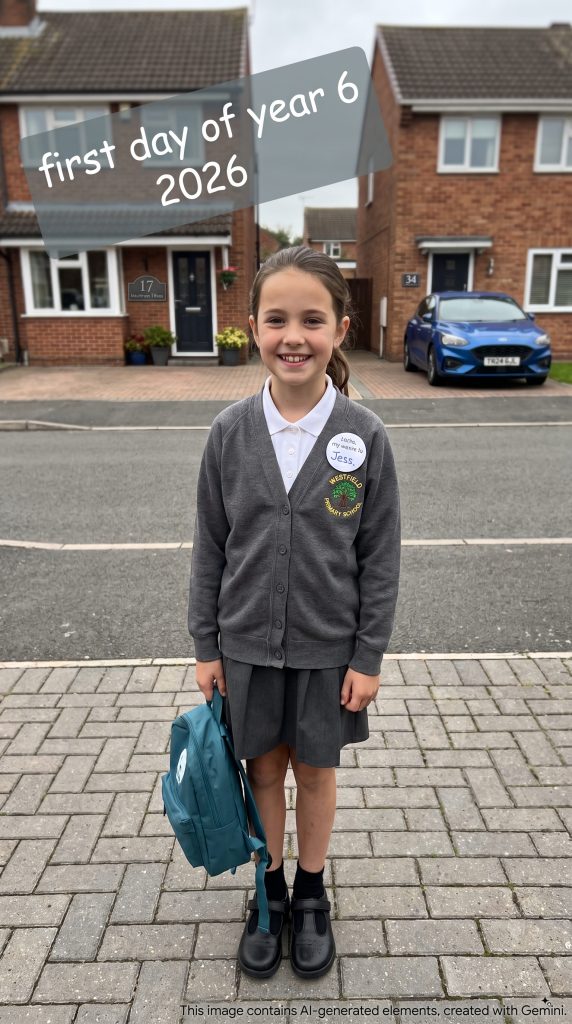
- Social Overlays: Snapchat (or similar) overlays to add additional context to your photos.
- School Branding & Uniforms: Crests, mascots, sports jerseys, or distinctive uniform ties reveal your child’s physical location five days a week, down to predictable arrival and dismissal times.
- Front Porch Backgrounds: House numbers, distinctive door frames, street signs, and visible car registration plates tie your child’s identity straight to your front door.
- Commute Landmarks: Local bus stop numbers, specific intersections, or recognizable parks map the exact route your child walks or rides unattended.
- Lanyards & Student Badges: High-resolution smartphone cameras can capture barcodes, QR codes, and student ID numbers, which can be scanned or decoded directly from the screen.
AI multiplies the threat exponentially
A decade ago, exploiting social media photos required a dedicated individual manually piecing together clues.
Modern automated pipelines have changed the economics of digital tracking.
- Facial Indexing & Biometric Scraping: Services like PimEyes and commercial-grade scrapers index human faces across public platforms. A clean, high-resolution portrait creates a persistent biometric signature that links your child across future photos, regardless of evolving appearance or changing usernames.
- Generative Deepfakes & Synthetic Abuse Material: Bad actors and predatory rings scrape clear facial references directly from social feeds to train or fine-tune image-synthesis models. In school settings, this fuel is increasingly weaponized for synthetic bullying and harassment campaigns.
- Voice Cloning & Emergency Scams: Back-to-school video clips featuring your child speaking provide training audio for generative voice synthesis. As little as 3 to 10 seconds of clear speech can clone a voice well enough to run targeted distress/grandparent fraud scams against relatives.
- Multimodal AI Geolocation: Modern vision models can deduce exact geographic coordinates from background reflections, vegetation species, utility poles, rooflines, and shadow angles.
3. Core Rules for Safter Milestone Photos
- Shoot indoors against a neutral wall: Eliminate street numbers, neighborhood vehicles, architectural landmarks, and front gardens entirely.
- Crop or obscure uniforms and logos: Frame portraits tightly from the shoulders up, or place a digital sticker over the school emblem before sharing.
- Keep the stat board offline: If you want a keepsake recording their favorite books, teachers, and dreams, write it down in a physical scrapbook or a secure local journal.
- Scrub EXIF metadata: Never assume an app strips your camera’s embedded GPS coordinates. Turn off location tags in your camera app natively.
- Enforce a posting delay: Never post in real time while standing on the sidewalk or walking through school gates. Delay posting by at least 24 to 48 hours to break real-time pattern tracking.
- Model digital consent: Ask your child if they want their photo posted online before publishing it. Teaching agency early is the foundation of their own digital literacy.
Leave a Reply